

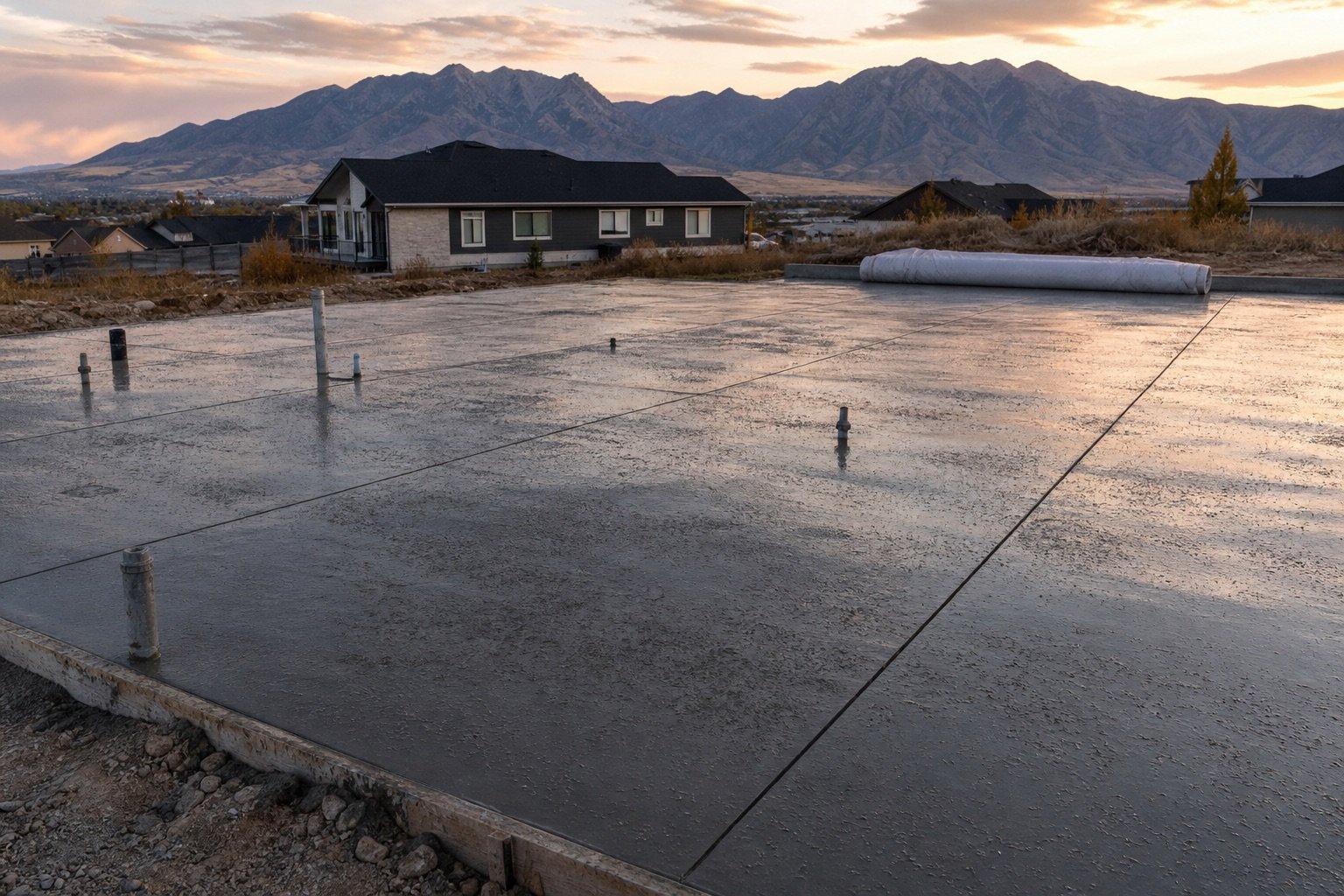
The short answer: concrete is hard enough to walk on in 24 to 48 hours, strong enough to drive a car on in 7 days, and reaches its full design strength at 28 days. But those numbers hide the more useful truth — concrete does not “dry,” it cures, and the difference between those two words is why some slabs last forty years and others start flaking after two winters.
Here is the complete timeline, what happens at each stage, and what you should and should not do to a new slab in Cache Valley.
The concrete curing timeline
| Time after pour | Approx. strength | What you can do |
|---|---|---|
| 4–8 hours | Initial set | Finishing and control joints cut (by the crew, not you) |
| 24–48 hours | ~25% | Light foot traffic. Forms typically stripped. |
| 7 days | ~70% | Passenger vehicles. Furniture on a patio. |
| 28 days | 100% design strength | Heavy vehicles, RVs, trucks. Sealing and coating. |
| Months–years | Continues slowly | Concrete keeps gaining strength indefinitely |
Curing is a chemical reaction, not evaporation
This is the single most misunderstood thing about concrete, and it drives almost every curing mistake.
Concrete hardens through hydration — cement particles reacting chemically with water to form interlocking crystals. Those crystals are the strength. The reaction needs water to continue, and it continues for weeks.
So when a slab surface looks dry on day two, that is not a finish line. It means the surface has lost the water the reaction still needs. If it dries out too fast, hydration stops near the surface before it has developed proper strength, and you get a slab that is strong in the middle and weak and dusty on top — the layer that has to survive tires, shovels, and road salt.
The practical consequence: keeping new concrete moist makes it stronger. Counterintuitive, and true. Water is the reactant, not the enemy.
What we do to cure a slab properly
- Curing compound sprayed on the fresh surface, forming a membrane that holds moisture in. The most common method on residential flatwork.
- Wet curing — keeping the surface continuously damp with sprinklers or wet burlap for the first several days. Most effective, most labor-intensive.
- Curing blankets or plastic sheeting to retain moisture and, in cold weather, heat.
The first 7 days matter most. Roughly 70 percent of the concrete’s ultimate strength develops in that window, and it is when protection makes the biggest difference.
How Cache Valley weather changes the timeline
Northern Utah is a demanding climate for concrete at both ends of the year.
Hot, dry summer weather
Our summers are hot with very low humidity, and that combination pulls water out of a fresh slab fast. Add wind and it accelerates further. Rapid surface drying causes plastic shrinkage cracking — those thin, random surface cracks that appear within hours of a pour.
The countermeasures are practical: pour early in the morning, use evaporation retarders, and get curing protection on quickly. This is a large part of why we start at 7:30 in the morning.
Cold weather
Hydration slows as temperature drops. Below about 50°F it slows noticeably; below 40°F it nearly stalls. Concrete that is simply cold cures slowly and will get there eventually. Concrete that freezes before it has reached about 500 psi is permanently damaged, because the water in it expands and disrupts the crystal structure that was forming. That damage cannot be undone.
Cold-weather pouring in Cache Valley is entirely possible with heated mixing water, accelerating admixtures, insulating blankets, and sometimes ground thawing before the pour. It costs more and requires closer monitoring, and it extends every milestone in the table above — a 7-day strength might take 10 to 14 days in November.
The best window
Late spring through early fall gives the most reliable conditions. That is also when everyone wants work done, so our calendar fills early. Homeowners who call in late winter get the dates they want.

Why concrete cracks — and why some cracking is normal
Concrete shrinks slightly as it cures, roughly one-sixteenth of an inch per ten feet. Since it is restrained by the ground beneath it and by its own edges, that shrinkage creates tension. Concrete is weak in tension. So it cracks.
This is not a defect. It is a material property. The job of good concrete work is not to prevent cracking — it is to control where it happens.
That is what control joints are for. Cut to about a quarter of the slab depth, within the first 6 to 12 hours, spaced roughly two to three times the slab thickness in feet — about 8 to 12 feet apart on a 4-inch slab. The joint creates a deliberate weak plane, and the crack forms down inside it where you cannot see it.
Cracking that is a problem looks different: cracks wider than about a quarter inch, cracks with vertical displacement between the two sides, or a pattern of cracking across the whole slab. Those indicate a base or drainage failure, not normal shrinkage. That distinction traces back to how the site was prepared, which is where the majority of concrete failures actually originate.

Protecting new concrete through its first winter
If you take one thing from this article, take this.
Do not put de-icing salt on concrete in its first winter. A new slab has not fully developed its surface durability, and chloride de-icers dramatically accelerate freeze-thaw damage. The result is scaling and spalling — the surface flaking away in sheets. It is permanent, and it is the most common avoidable damage we see in Cache Valley.
Instead:
- Use sand for traction through the first winter.
- After the first year, use de-icers sparingly. Never use ammonium sulfate or ammonium nitrate — they chemically attack concrete. Magnesium and calcium chloride are less damaging than rock salt but are not harmless.
- Shovel rather than melt where you can. A plastic-edged shovel does no harm.
- Rinse salt-laden slush off garage floors periodically through winter.
- Consider a penetrating sealer after the first year, reapplied every few years.
Frequently asked questions
Can it rain on fresh concrete?
It depends on timing. Rain during finishing is a genuine problem — it adds water to the surface paste and weakens it. Rain after the surface has set is largely harmless and effectively free wet curing. If a shower is forecast during a pour, we cover the slab.
Why is my new concrete a blotchy color?
Color variation in the first weeks is normal and usually evens out over several months. It comes from uneven moisture loss, differences between truckloads, and the curing method. Efflorescence — a white powdery bloom — is also common and typically weathers off.
Why does my new slab produce dust?
Surface dusting usually means the top layer did not hydrate properly, from drying too fast, finishing water into the surface, or curing that started too late. A concrete densifier or sealer normally resolves it.
Can I speed curing up?
Somewhat. High early-strength mixes and accelerating admixtures reach usable strength sooner, at a cost. What you cannot do is skip the chemistry. Driving on a slab early does not usually crack it visibly on day one — it creates micro-damage that shows up as premature cracking in a couple of years.
How long before sealing or coating?
Most sealers require a minimum of 28 days. Epoxy and acrylic sport coatings often want longer plus a moisture test. Applying a coating to green concrete is how you get peeling and bubbling later.
The rest of the guides
Curing applies to every pour, but each type of project has its own considerations:
- Concrete driveway cost in Cache Valley
- Concrete patio and walkway installation
- Garage and basement concrete floors
- Site preparation and excavation
- Backyard sport courts and RV pads
- Concrete mow strips and decorative concrete
- Commercial concrete services
Concrete done by people who wait for it
Bustillos Concrete has been pouring and curing concrete across Cache Valley for 8 years independently, with 19 years of hands-on experience. We serve Logan, Smithfield, Hyrum, Providence, Nibley, Richmond, North Logan, Millville, and Trenton, plus Preston and Franklin, Idaho.
We will tell you honestly when your slab is ready to use — not when it would be convenient for it to be ready.
Get your free estimate — or browse all our concrete services in Cache Valley.