

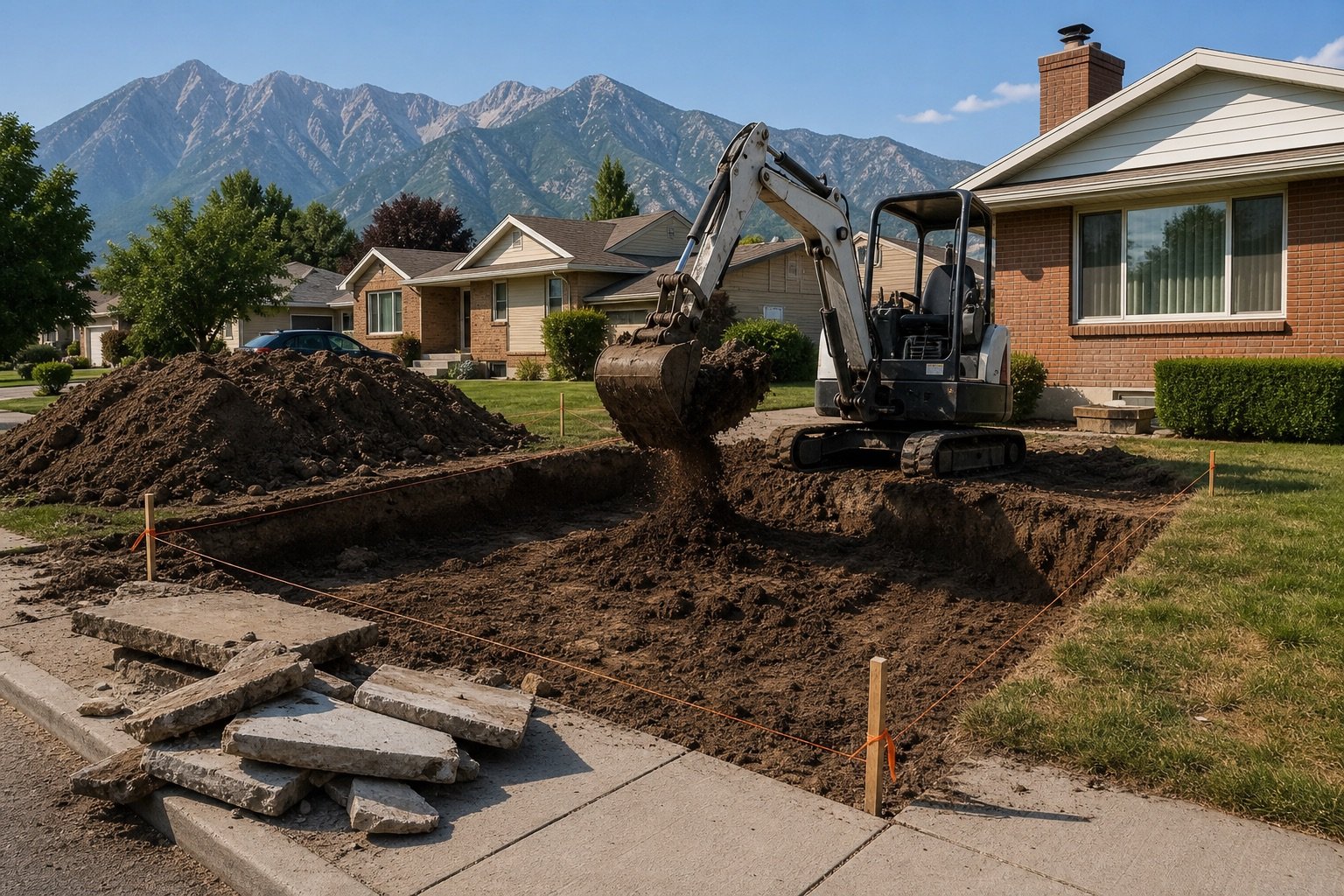
Almost every failed slab we are called out to look at in Cache Valley failed for the same reason, and it is not the concrete. It is what was underneath it. Concrete is only as good as the ground it sits on, and base preparation is the part of the job that is completely invisible the day after it is finished — which is exactly why it is the first thing an underpriced bid quietly leaves out.
This guide explains what proper excavation and site preparation involves in northern Utah, why it matters more here than in milder climates, and why we offer it as a standalone service.
Why the base decides whether your concrete cracks
Concrete is enormously strong in compression and very weak in tension. Push down on it and it holds. Bend it and it breaks. A slab sitting on a uniform, well-compacted base is being pushed on evenly, and it holds.
A slab sitting on soft spots, loose fill, or ground that settles unevenly is being bent. It does not matter how good the mix was or how skilled the finisher was. The slab spans the void, tension develops on its underside, and it cracks. Every time.
This is why two driveways poured with the identical concrete on the same street can look completely different after five winters. The difference was decided before the truck ever arrived.

What proper site preparation involves
Excavation to depth
The area is cut out to accommodate both the slab thickness and the base beneath it. For a 4-inch driveway on 4 to 6 inches of base, that is 8 to 10 inches of excavation below finished grade. Cutting shallow to save on haul-off and base material is the single most common corner cut in residential concrete.
Organic material — topsoil, roots, sod, old landscaping fabric — all has to come out. Organics decompose, and when they do they leave voids.
Assessing and correcting the subgrade
Cache Valley soils vary a great deal over short distances. Some sites are gravelly and drain beautifully. Others are heavy clay that holds water, swells when wet, and shrinks when dry — which means the ground itself moves seasonally. Some lots, particularly in newer subdivisions, are built on fill that was never properly compacted.
If the subgrade is soft, it gets corrected: over-excavated and replaced, or stabilized with geotextile fabric before base goes down. Pouring on a soft subgrade and hoping is not a plan.
Grading for drainage
Everything slopes away from the house. The subgrade is shaped before the base goes in, so the fall is built from the ground up rather than created by varying the slab thickness. Water that reaches the base and cannot leave will freeze, expand, and lift the slab above it.
Base material and compaction
We install road base — typically a three-quarter-inch minus aggregate with fines that lock together when compacted. It goes in at 4 to 6 inches for residential flatwork, more under heavy loads.
Critically, it is compacted in lifts. Dumping six inches of gravel and running a compactor over the top of it compacts the top two inches and leaves the rest loose. Placing it in two or three shallower layers and compacting each one is what produces a base that actually behaves like a solid surface.
Forming and reinforcement
Forms establish the edges, the elevations, and the slope. Reinforcement goes in on chairs so it sits within the slab rather than resting on the base where it contributes nothing.
The freeze-thaw problem in northern Utah
Cache Valley cycles above and below freezing repeatedly through the winter, sometimes within a single day. Water in the soil expands roughly 9 percent when it freezes. If the base holds water, that expansion lifts the slab — frost heave — and when it thaws, the slab settles back down, but never quite evenly.
Repeat that dozens of times per winter across several winters and you get the cracked, tilted, uneven flatwork that is everywhere in older northern Utah neighborhoods.
The defense is entirely about water management. A free-draining compacted base gives water somewhere to go instead of somewhere to sit. Frost depth in this region is commonly around 30 inches, which matters for footings and posts — your city building department will confirm the figure they enforce, and requirements differ between Logan, Smithfield, Hyrum, and the smaller municipalities.
Excavation as a standalone service
Most concrete contractors will only excavate as part of a pour they are doing. We do it either way, which is unusual in this market and genuinely useful if you are:
- Doing your own concrete work but do not own an excavator or a plate compactor.
- Preparing for a shed, shop, or outbuilding that needs a level, compacted pad.
- Excavating for a residential foundation ahead of a builder.
- Trenching for utilities or drainage — water, power, gas, or a French drain.
- Regrading a yard that drains toward the house instead of away from it.
- Removing an old slab and stopping there for now.
Site preparation and excavation work starts at $1,300. If you want the ground made ready and nothing else, that is a job we are happy to take.
Call before you dig — every time
Utah law requires you to have underground utilities located before excavating. It is free, it takes a couple of working days, and hitting a gas or fiber line is both dangerous and extremely expensive.
Call 811 or use Blue Stakes of Utah at least two working days before any digging. We handle the locate request on projects we excavate, but if you are digging yourself, make the call. There is no version of this worth skipping.

Reading a bid for base preparation
When you are comparing quotes, the base is where the differences hide. Ask each contractor three specific questions:
- How deep are you excavating, and how many inches of base are you installing? A vague answer is an answer.
- How is the base being compacted, and in how many lifts?
- What are you doing about drainage and slope?
A bid that is several thousand dollars below the others is not usually finding efficiencies. It is usually pouring on four inches less base. You will not be able to tell for about three years, at which point the contractor’s warranty has expired and the slab is yours.
Frequently asked questions
How long does excavation and base prep take?
For a typical residential driveway or patio, excavation and base work is generally one day, sometimes two if the site needs significant correction or there is a lot of demolition to haul away. We start at 7:30 in the morning and work the stage through.
Do you haul away the old concrete and soil?
Yes, removal and disposal are included in our quotes and shown as part of the scope. Dump fees are a real cost and we would rather you see them than find them later.
Can you fix a yard that drains toward my house?
Usually, yes. Regrading, swales, and drainage trenching are all part of what we do. This is worth addressing before it becomes a foundation problem, and it is far cheaper than the alternative.
What if you find something unexpected during excavation?
It happens — buried debris, an old foundation, a soft spot nobody knew about, groundwater. We stop, show you what we found, and explain the options and what each one costs before doing anything. You will not find out about it on the final invoice.
Do I need a permit to excavate?
It depends on scope and location. Work within your property line for flatwork usually does not require one; work in the public right-of-way, significant grade changes, and foundation excavation often do. We will tell you what your city requires.
Start with the part that lasts
Bustillos Concrete has been doing excavation and site preparation across Cache Valley for 8 years, with 19 years of concrete experience behind it. We serve Logan, Smithfield, Hyrum, Providence, Nibley, Richmond, North Logan, Millville, and Trenton, plus Preston and Franklin, Idaho, within about 50 miles of Logan.
Whether it is prep for a slab we are pouring or prep for someone else’s, the standard is the same.
Request your free excavation estimate — or read more about concrete site preparation and excavation.