

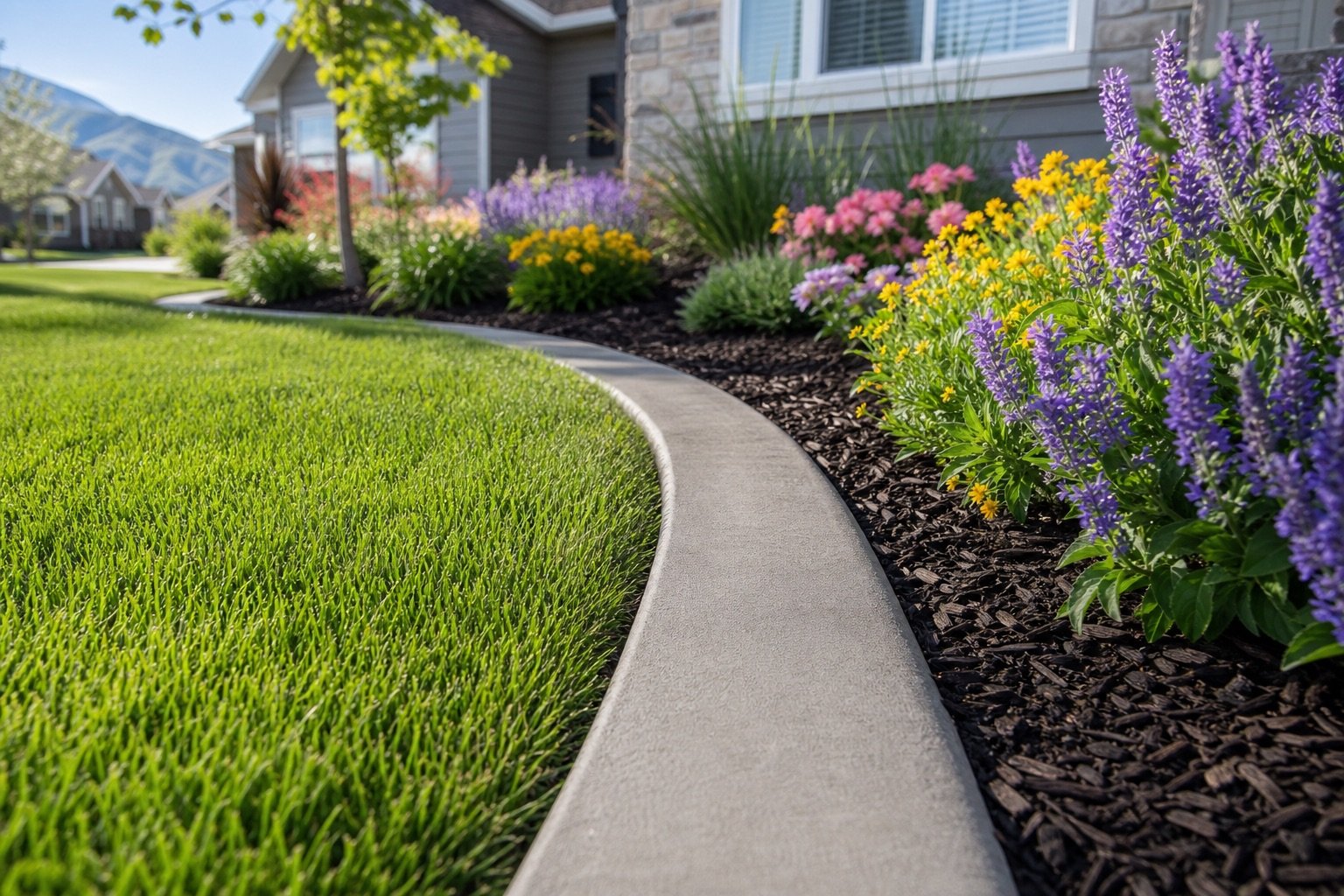
Of everything we pour, concrete mow strips deliver the most visible improvement for the least money — and almost nobody in Cache Valley asks for them by name, because most homeowners do not know they are an option. If you have ever spent a Saturday on your knees with a string trimmer cutting grass away from a flower bed, this is the article for you.
What a mow strip actually is
A mow strip is a narrow band of concrete poured flush with the lawn, running between the turf and whatever is next to it — a planting bed, a fence line, a wall, a gravel path. Typically 4 to 8 inches wide and 3 to 4 inches thick.
Its job is simple. You run one mower wheel along the strip and it cuts the grass edge cleanly to the end of the blade’s reach. No trimming, no edging, no scalped brown line where you cut too deep. It also physically stops grass roots and bark mulch from migrating into each other.
People call them mow strips, mowing bands, concrete edging, or landscape borders. Same thing.
Why they are worth it in Cache Valley specifically
Three reasons this region rewards them more than most.
Our growing season is short and intense. Kentucky bluegrass, which is on most lawns here, grows aggressively from May through September and spreads by rhizomes — underground runners that push sideways into beds relentlessly. A physical barrier at the boundary is far more effective than repeatedly cutting the invasion back.
Sprinkler systems and edging fight each other. Plastic and metal edging heaves out of the ground with our freeze-thaw cycling. Every spring it needs to be stomped back in, and eventually the buckled edge catches the mower. Concrete at proper depth on a compacted base does not move.
Bark mulch is standard here, and it travels. Without a defined edge, mulch ends up in the lawn and gets thrown by the mower. A raised or flush concrete lip holds it where you put it.
Mow strips versus the alternatives
- Plastic edging. Cheapest, and it shows. Heaves in winter, becomes brittle in UV, and typically needs replacing within a few years.
- Steel edging. Better and longer-lived, but expensive per foot, and the exposed top edge is a genuine hazard for bare feet and pets.
- Paver or brick edging. Attractive, but individual units shift over time and weeds grow through the joints. Also labor-intensive to install correctly.
- Concrete mow strip. Highest up-front cost of the four, and effectively the last one you will install. Continuous, no joints for weeds, no components to shift.
The economics favor concrete over a ten-year horizon almost every time, and there is no ongoing maintenance to think about.

Design decisions worth making up front
Width
Four inches is the minimum that functions. Six to eight inches is better, because it gives the mower wheel a genuine surface to track along rather than a line to balance on. Measure the wheel spacing on your mower before deciding.
Height
Set flush with the lawn if the strip is primarily for mowing — the wheel rides on it and the blade clears the grass edge. Set it an inch or two proud if you want to retain mulch or gravel on the bed side. You can do both on the same run, flush along the turf and slightly raised on the bed side.
Curves
Concrete curves beautifully, and this is where it outperforms every rigid alternative. Flowing curves around beds and tree rings look intentional and are far easier to mow than tight corners. If you are designing from scratch, avoid sharp inside angles — the mower cannot reach into them.
Finish
A smooth troweled top with rounded tooled edges is standard and looks clean. You can also color, stamp, or expose the aggregate to match a patio or walkway. If you already have decorative flatwork, matching the strip to it pulls the whole yard together.

Decorative concrete beyond mow strips
The same techniques scale up to larger features, and homeowners often add them once they have seen the edging done well.
Stamped concrete
Textured mats pressed into fresh concrete produce convincing flagstone, slate, brick, or wood plank. It costs substantially less than the natural material and installs as one monolithic surface with no joints for weeds. Our decorative and stamped work starts at $1,800.
Integral color
Pigment mixed through the entire batch rather than applied to the surface. It will not wear through or fade off, and it weathers evenly. Expect natural variation between truckloads — that is the material behaving normally.
Exposed aggregate
The surface paste is washed off to reveal the stone. Extremely durable, excellent traction, and very forgiving of dirt. Well suited to Cache Valley winters.
Tree rings, seat walls, and garden borders
A poured ring around a mature tree eliminates the worst trimming job in any yard. Low seat walls define a patio edge and add usable seating without furniture.
What it costs
Mow strips are priced by the linear foot, and the cost is driven by total length, width, how many curves are involved, and access for the crew and materials. Because the pour volume is small relative to the setup, running a longer stretch in one visit is significantly more economical per foot than doing short sections across multiple visits.
Our residential concrete work starts at $1,300, with decorative and stamped finishes starting at $1,800. If you are already having a patio or walkway poured, adding mow strips to the same visit is the cheapest they will ever be — the crew, the forms, and the concrete delivery are already on site.
Frequently asked questions
Will a mow strip really stop grass spreading into my beds?
It stops rhizome spread at the barrier, which is the main mechanism, provided the strip goes deep enough. It will not stop seed blowing over the top — nothing does. In practice it eliminates the great majority of bed invasion and all of the trimming.
How long does installation take?
Most residential mow strip projects are a one to two day job depending on total footage and how much excavation the line needs. Forming the curves is the time-consuming part, not the pour.
Can you install one around an existing lawn without tearing it up?
Yes. We cut a narrow trench along the line, form it, and pour. There is disturbance in a band along the edge, but the lawn either side is left intact and recovers quickly.
Will it crack?
Narrow concrete elements are poured with control joints at intervals so any cracking follows a tooled line. On a compacted base with proper depth, mow strips hold up very well — they carry no vehicle load, which is the thing that breaks most residential concrete.
Can it match my existing driveway or patio?
We match finish and color as closely as the materials allow. A perfect match to aged concrete is not achievable, since existing concrete has weathered and carries years of exposure, but new work blends noticeably over the first couple of seasons.
When is the best time to have it done?
Spring through fall. Early spring is ideal if you want it in place before the growing season, which is when it saves you the most work.
The cheapest upgrade in your yard
Bustillos Concrete installs mow strips, decorative borders, and stamped concrete throughout Cache Valley, with 19 years of concrete experience and 8 years operating independently from Logan. We serve Logan, Smithfield, Hyrum, Providence, Nibley, Richmond, North Logan, Millville, and Trenton, plus Preston and Franklin, Idaho.
It is a small job by concrete standards and one of the most satisfying, because you notice the difference every single time you mow.
Get your free mow strip estimate — or read more about our decorative concrete and mow strip services.