

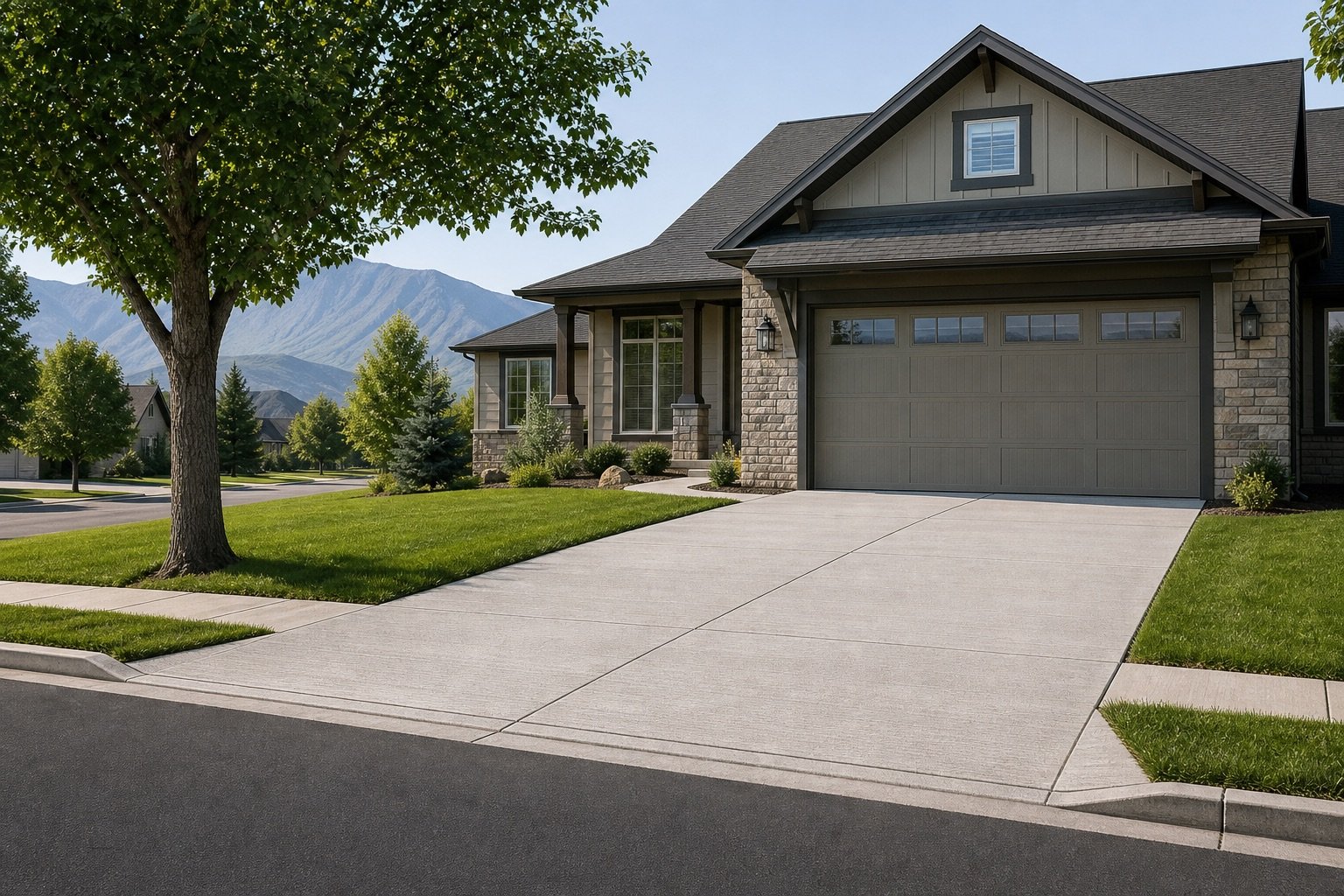
If you are pricing a new concrete driveway in Logan or anywhere in Cache Valley, you have probably noticed the quotes come back further apart than you expected. One contractor says one number, another says something thousands of dollars higher, and neither of them explains why. This guide breaks down what actually drives the price of a concrete driveway in northern Utah, what you should expect to see on a legitimate bid, and where homeowners quietly lose money.
What a concrete driveway actually costs in Cache Valley
Driveway pricing is calculated by the square foot, then adjusted for everything that makes your particular site harder or easier than average. For a standard residential pour in the Logan area, most projects land in the range of $8 to $15 per square foot for a plain broom finish, and higher once you add decorative work.
A typical two-car driveway runs roughly 20 by 40 feet, or 800 square feet. That puts a straightforward replacement somewhere in the mid four figures to low five figures depending on site conditions. At Bustillos Concrete, residential driveway projects start at $1,300, with stamped and colored work starting at $1,800.
Those are starting points, not your quote. The only number that matters is the one written for your specific driveway after someone has physically looked at it — and ours is free.
What moves the number up or down
- Square footage. The single biggest factor. Larger pours are also slightly cheaper per square foot, since mobilization is spread across more area.
- Slab thickness. Four inches is standard for passenger vehicles. Five to six inches with heavier reinforcement is appropriate if you will park a truck, trailer, or RV on it.
- Demolition and haul-off. Tearing out and disposing of an existing slab is real labor and real dump fees. Expect it to be a visible line item.
- Excavation and base depth. If your soil drains poorly or the grade is off, you need more base material. This is where cheap bids cut corners.
- Reinforcement. Rebar costs more than wire mesh and performs better. See below.
- Access. If a concrete truck cannot reach the pour, the concrete has to be wheelbarrowed or pumped, and that adds cost.
- Finish. Broom finish is the baseline. Stamped, colored, and exposed aggregate finishes all add material and skilled labor.
Why Cache Valley driveways cost less than Salt Lake driveways
Homeowners here routinely collect bids from Salt Lake City contractors, and those bids come in high for a reason that has nothing to do with quality. A crew driving up from the Wasatch Front is billing you for windshield time, fuel, and the overhead of a larger operation. That cost gets buried in the square-foot price.
We have had Cache Valley customers tell us we came in $10,000 below the next bid from a group out of Salt Lake for the same scope of work. We are not doing anything exotic to get there. We are simply based in Logan, we run lean, and we are not driving 80 miles each way to reach your house.
If you are gathering quotes, get at least one local number before you sign anything. The spread surprises people.

What a proper driveway build looks like in northern Utah
Cache Valley is hard on concrete. We get real winters, real freeze-thaw cycling, and road salt. A driveway that would last thirty years in a mild climate can spall and crack here in five if it is built without accounting for that.
1. Excavation and grading
The old slab comes out, and the subgrade is cut to depth and sloped to drain away from your house and garage. Water that sits under or against concrete is the enemy. Grading is not glamorous and you will never see it again once the pour is done, which is exactly why it is the first thing an underpriced bid skips.
2. Base preparation
We install and compact four to six inches of road base. Compaction matters as much as depth — loose base settles, and settled base cracks the slab above it. This step is the foundation of everything, and it is worth reading more about in our guide to site preparation and excavation.
3. Forming and reinforcement
Forms set the edges and the slope. Then reinforcement goes in, held up on chairs so it sits in the middle of the slab rather than lying on the dirt where it does nothing.
4. The pour and finish
For exterior flatwork in this climate we use air-entrained concrete, typically in the 4,000 psi range. The air entrainment creates microscopic bubbles that give freezing water somewhere to expand into. Skipping it is the most common cause of surface spalling in Utah driveways. The surface then gets a broom finish for traction, which matters on an icy January morning.
5. Joints and curing
Control joints get cut within the first day, spaced roughly two to three times the slab thickness in feet — so about 8 to 12 feet apart on a 4-inch slab. Concrete is going to crack. Joints decide where. After that, curing takes over, and it is more important than most people realize.
Rebar or wire mesh?
Both add tensile strength to a material that has almost none on its own. The practical difference is placement. Wire mesh is cheaper, but it is commonly laid flat on the base and never lifted into position during the pour, which makes it close to useless. Rebar on chairs stays where it belongs.
For a driveway that will see truck or RV weight, we recommend rebar in a grid. For a light-duty passenger car driveway, properly supported mesh can be adequate. If a bid does not say which one you are getting, ask.

Concrete versus asphalt in Utah
Asphalt is cheaper up front, usually noticeably so. It is also softer, which means it handles ground movement well but rutted and deformed under sustained heat and point loads like trailer jacks and motorcycle kickstands. It needs resealing every few years.
Concrete costs more initially and lasts substantially longer with less maintenance, typically 30 or more years when it is built correctly. It also holds value better on curb appeal, and it accepts decorative finishes that asphalt simply cannot. For most Cache Valley homeowners planning to stay put, concrete is the better long-run purchase.
Protecting a new driveway through its first Utah winter
This is the part almost nobody tells homeowners, and it causes an enormous amount of avoidable damage.
Do not use de-icing salt on concrete during its first winter. New concrete is still gaining strength and its surface is at its most vulnerable. Chloride de-icers accelerate freeze-thaw damage and cause the surface to flake. Use sand for traction instead. After the first winter, use de-icers sparingly, and avoid ammonium sulfate and ammonium nitrate entirely — they chemically attack concrete.
Also worth knowing: keep heavy vehicles off for the first 28 days, keep sprinklers from soaking the slab edge, and consider a penetrating sealer after the first year.
Repair or replace?
Not every damaged driveway needs to come out. A few honest guidelines:
- Hairline cracks are normal and usually cosmetic. Seal them and move on.
- Surface spalling and flaking with a sound slab underneath can often be resurfaced.
- Cracks wider than about a quarter inch, with vertical displacement between the two sides, indicate a base or drainage problem. Resurfacing over that just hides it temporarily.
- Widespread cracking, sinking sections, or a slab that has broken into many pieces means the base has failed. Replacement is the honest answer.
A contractor who recommends full replacement for every driveway is not diagnosing, they are selling. We will tell you when a repair is the right call.
Frequently asked questions
How long before I can drive on a new concrete driveway?
Wait 7 days for passenger vehicles and 28 days for heavy trucks or RVs. Concrete reaches roughly 70 percent of its design strength at 7 days and its full rated strength at 28. We cover the full timeline in our guide to how long concrete takes to cure.
What time of year is best to pour a driveway in Cache Valley?
Late spring through early fall is ideal. Concrete can be poured in cold weather with blankets, heated water, and accelerators, but it costs more and requires more care. Booking in late winter for a spring slot is the smart play, since the calendar fills fast once the ground thaws.
Can you extend or widen my existing driveway instead of replacing it?
Yes. Extensions, widening, and RV pads are common requests. We match thickness and finish as closely as possible and tie the new work in with a proper joint. A perfect color match with aged concrete is not realistic, since existing concrete has weathered, but the new section will blend more over time.
Do I need a permit for a driveway in Logan?
Work within your property line generally does not require a permit, but anything touching the public right-of-way — most commonly the apron where your driveway meets the street — usually does. Requirements vary between Logan, Smithfield, Hyrum, Providence, and the smaller municipalities. We handle this as part of the job and will tell you what your city requires.
How long does the whole project take?
Most residential driveways are demo, excavation, base, and pour across two to three working days. We start at 7:30 in the morning and work until the day’s stage is finished. Then curing time is on the concrete’s schedule, not ours.
Get a real number for your driveway
Bustillos Concrete has been pouring driveways across Cache Valley for 8 years independently, backed by 19 years of hands-on concrete experience. We serve Logan, Smithfield, Hyrum, Providence, Nibley, Richmond, North Logan, Millville, and Trenton, along with Preston and Franklin in Idaho.
We quote in writing, and the price you are quoted is the price you are charged. No mid-project surprises.
Request your free driveway estimate — or read more about our concrete driveway installation and repair services.