

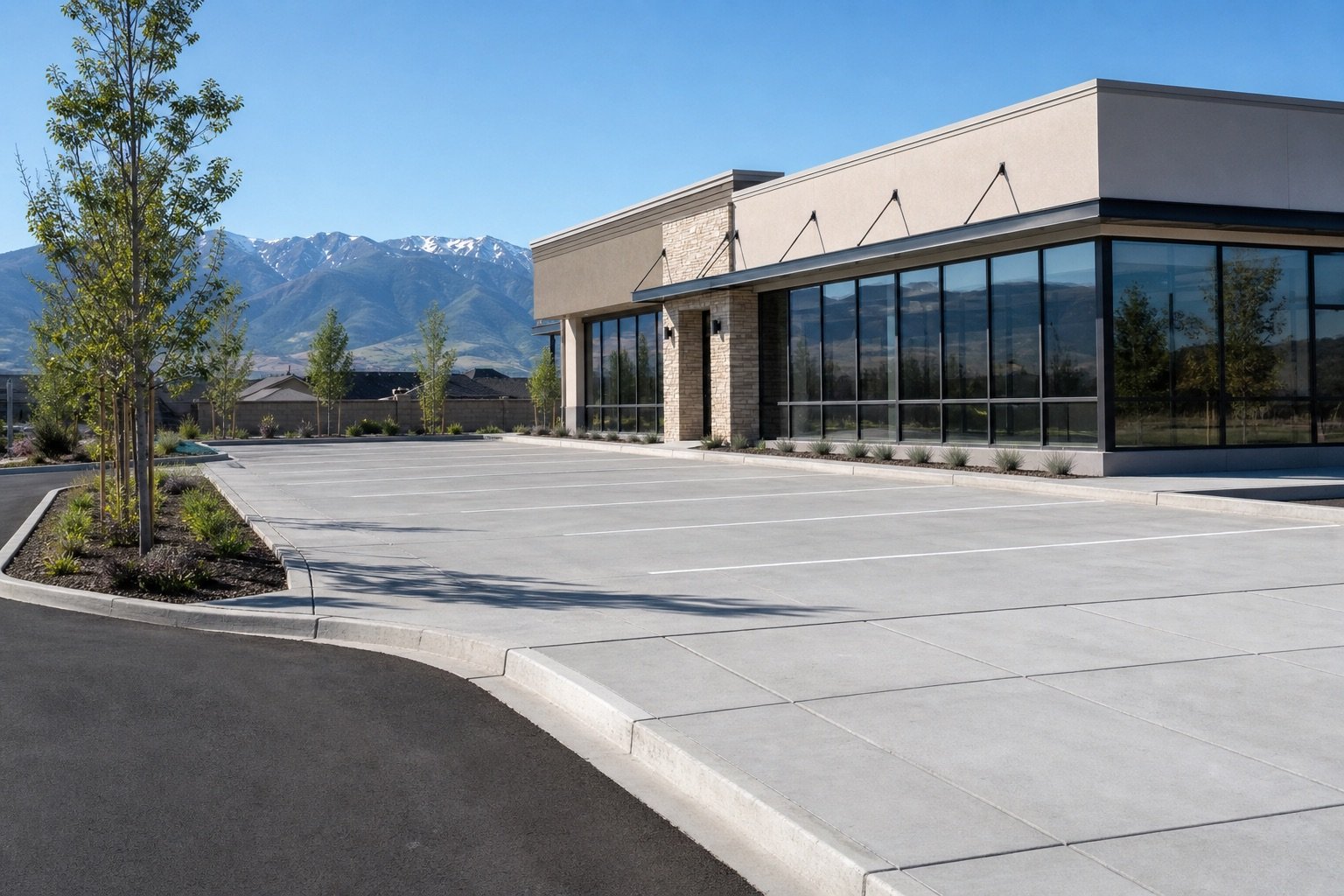
Commercial concrete is judged by different criteria than residential work. A homeowner cares how the driveway looks. A business owner cares that the parking lot drains, that the walkway meets accessibility code, that the work happens without closing the business, and that it does not need redoing in four years. This guide covers commercial and light commercial concrete in Cache Valley — what it involves, what it costs, and how to schedule it without losing revenue.
What counts as light commercial
Most commercial concrete in a market this size is not big-box construction. It is the everyday flatwork that keeps small businesses functioning:
- Parking areas, stalls, and drive lanes
- Sidewalks, entry walkways, and landings
- Curb, gutter, and wheel stops
- ADA-compliant access ramps and accessible parking
- Loading dock aprons and service pads
- Dumpster enclosure pads
- Equipment pads and generator bases
- Warehouse, shop, and office slabs
Our commercial projects start at $2,000. We take selective commercial work rather than pursuing it as our primary business, which means we are honest about scope: if a project is beyond what a small crew should take on, we will say so rather than take your deposit and overextend.
Why commercial slabs are built differently
Loading
A residential driveway carries passenger cars. A commercial lot carries delivery trucks, garbage trucks, and in some cases semi traffic. A fully loaded garbage truck can exceed 50,000 pounds, and it arrives on the same spot every week.
That changes the specification. Where residential flatwork is 4 inches, commercial areas seeing truck traffic are typically 6 to 8 inches, on a deeper compacted base, with a rebar grid rather than mesh. Dumpster pads in particular are frequently underbuilt, then fail within a couple of years because a heavy truck sets its lifting arms in the identical position 52 times a year.
Traffic frequency
Commercial concrete does not get a rest. Residential flatwork sees a handful of vehicle passes a day; a business lot may see hundreds. Cumulative loading is what drives the thickness and jointing decisions.
Drainage across a large area
A parking lot is a big surface, and water has to be routed deliberately across all of it — to inlets, to the gutter line, off the property. Ponding water is a liability problem in a Cache Valley winter, where a low spot becomes a sheet of ice in the exact place customers walk. Drainage design is a bigger part of the job than the concrete itself.

ADA compliance is not optional
Any commercial property serving the public has accessibility obligations, and concrete is where most of them physically land. The requirements are specific and they are enforced:
- Ramp running slope no steeper than 1:12 — one inch of rise per twelve inches of run.
- Cross slope on ramps and accessible routes no more than 1:48, about 2 percent.
- Accessible parking stalls and access aisles no steeper than 1:48 in any direction, which in practice means very close to flat while still shedding water.
- Detectable warning surfaces — the truncated dome panels — where a route crosses into vehicular traffic.
- Level landings at the top and bottom of ramps, and handrails where the rise requires them.
These tolerances are tight, and they are the reason accessible work costs more per square foot than ordinary flatwork. Getting a 2 percent cross slope right across a stall while still draining takes deliberate grading. Concrete that is out of compliance has to be removed and replaced — there is no adjusting it afterward.
Requirements vary by jurisdiction and by whether the work is new construction or alteration. Logan, Smithfield, Hyrum, and the smaller Cache Valley municipalities each administer their own permitting, and work in the public right-of-way generally requires approval and inspection.
Scheduling around an operating business
The concrete is usually the easy part. The hard part is that you cannot close for a week.
Practical approaches we use:
- Phasing. Pour the lot in sections so part of it stays open. Costs a little more in mobilization and produces more joints, and it is almost always worth it.
- Working the off-season. Every business has a slow stretch. Scheduling the pour into it is the single biggest thing you can do to reduce disruption.
- Protecting the entrance. Keeping at least one compliant accessible route open throughout is both a courtesy and, for many properties, a requirement.
- Being realistic about cure time. This is where expectations break down most often. The concrete does not care about your reopening date.
Curing is the constraint that cannot be compressed: foot traffic after 24 to 48 hours, light vehicles at 7 days, heavy trucks at 28. High early-strength mixes can shorten that, at a cost. The full picture is in our guide to how long concrete takes to cure. Plan the reopening around the concrete, not the other way around.

Curb, gutter, and the details that fail first
Curb and gutter does the unglamorous work of routing water and defining the edge of the paving. When it fails, water goes where it should not — under the lot, against the building, across the sidewalk to freeze.
Common failure points on commercial properties, in the order we see them:
- Dumpster pads that were poured at parking-lot thickness.
- The transition between concrete and asphalt, where differential settlement opens a gap that takes in water.
- Drive approaches at the street, which take the heaviest turning loads on the property.
- Areas under downspout discharge, where concentrated water undermines the base.
If you are budgeting repairs, these four are where the money goes furthest.
Why local pricing matters more on commercial work
The travel-cost advantage that saves Cache Valley homeowners money on driveways scales up on commercial jobs. A contractor coming from the Wasatch Front is billing mobilization, crew travel, and equipment transport into every day of a multi-day project. On a larger scope that compounds.
We are based in Logan. Our crew is not driving 80 miles each way, and we are not carrying the overhead of a large operation. Businesses here get the same work for meaningfully less, which is the same reason our residential customers have told us we came in $10,000 below Salt Lake bids.
Frequently asked questions
How much does commercial concrete cost per square foot?
More than residential, because of thickness, reinforcement, base depth, and tighter tolerances. Expect a meaningful premium over residential flatwork rates, with ADA work and heavy-load areas higher still. Our commercial projects start at $2,000, and we quote in writing after seeing the site.
Do you carry insurance for commercial work?
Yes. We will provide current certificates of insurance for your records before work begins, and we can name your entity as additional insured where your lease or lender requires it.
Can you work nights or weekends?
For projects where daytime work would shut down a business, yes — it can be arranged. Cold-weather night pours in a Cache Valley winter carry real limitations, so the season affects what is practical.
Can you repair sections instead of replacing the whole lot?
Usually. Full-depth patching of failed panels is common and far cheaper than wholesale replacement. The question is always whether the base beneath is sound. If it is, sectional repair is the right answer; if the base has failed, patching buys a short reprieve.
Who handles permits and inspections?
We will tell you what your municipality requires and coordinate inspections for the work we perform. Property owners are generally the permit applicant of record for site work — we will make clear who files what before we start.
Talk to a local contractor about your property
Bustillos Concrete takes selective commercial and light commercial work throughout Cache Valley, with 19 years of concrete experience and 8 years operating independently from Logan. We serve Logan, Smithfield, Hyrum, Providence, Nibley, Richmond, North Logan, Millville, and Trenton, plus Preston and Franklin, Idaho.
Written quotes, transparent scope, and the price quoted is the price charged.
Request a commercial concrete quote — or read more about our commercial concrete services.