

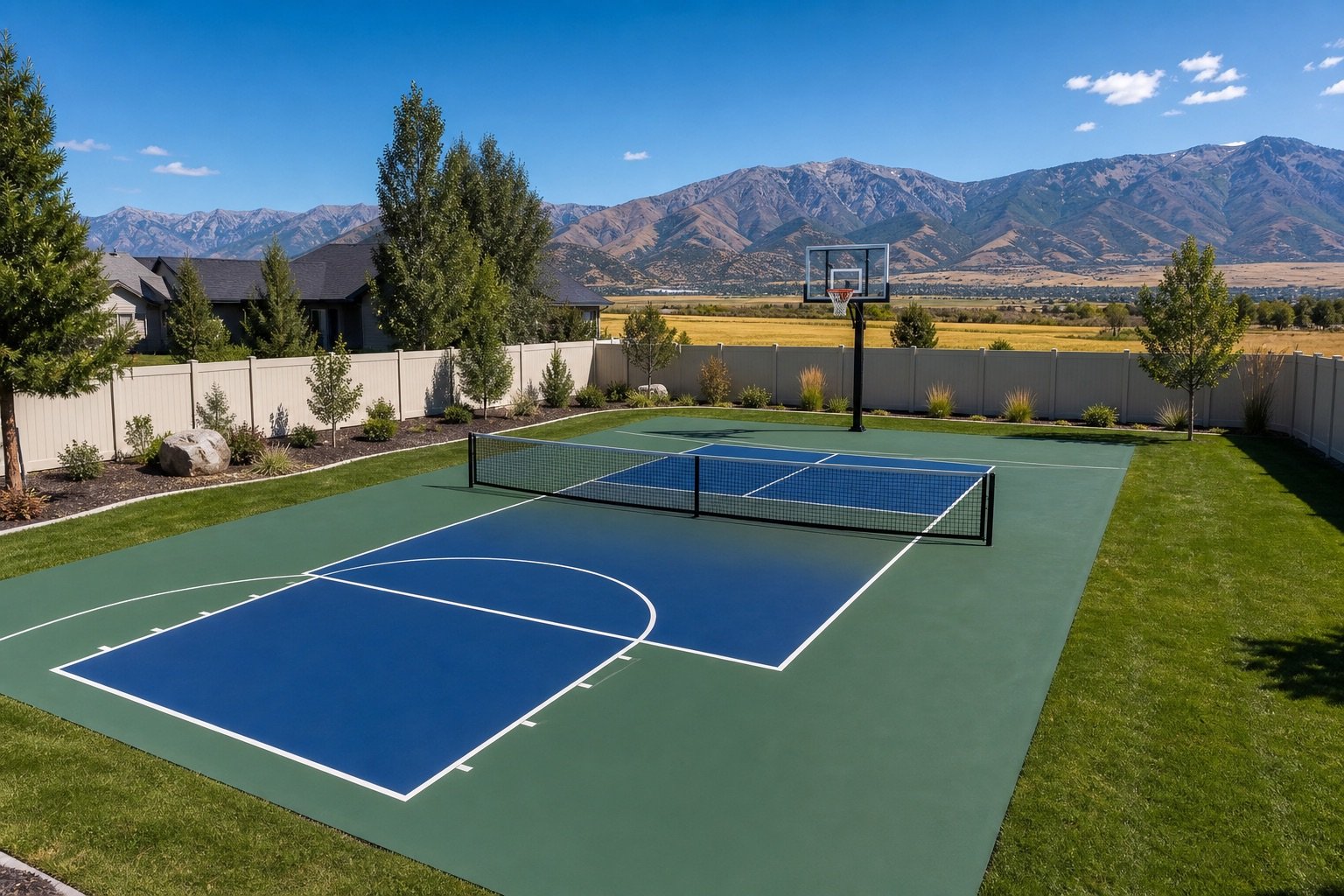
Backyard sport courts have gone from a rarity to a regular request in Cache Valley, and pickleball is most of the reason. A court is also one of the least forgiving things you can pour. A driveway with a slight dip is a cosmetic annoyance. A court with a slight dip has a puddle in the middle of the kitchen line and a ball that bounces wrong. This guide covers what goes into building a sport court or RV pad properly in northern Utah.
Court dimensions: get these right first
The playing area and the slab are two different numbers, and people conflate them constantly.
Pickleball
A pickleball court’s playing surface is 20 by 44 feet. But you cannot pour exactly that and expect to play on it — you need run-off space behind the baselines and beside the sidelines. The recommended total footprint is 30 by 60 feet. A tight but workable minimum is around 24 by 54.
Pouring 20 by 44 and discovering there is nowhere to chase a lob is a mistake that cannot be corrected afterward.
Basketball
A half court is commonly poured at 30 by 30 up to 40 by 50 feet. A regulation high-school half court is 42 by 50. Most residential courts land between those, sized to the yard.
Combination courts
This is the most popular configuration we build, and it is the most efficient use of the slab. A 30 by 60 pour comfortably holds a full pickleball court with proper run-off, and a basketball hoop at one end gives you a generous half court on the same concrete. Two sports, one pour, one base.

What makes a court different from a driveway
Flatness is the whole job
A court has to be genuinely planar. Standing water is the enemy — it stains the surface, it degrades the coating, and in Cache Valley it freezes. The surface needs enough slope to shed water, typically about 1 percent in a single plane from one side to the other, and it must be consistent. Sloping from the center outward in two directions creates a ridge you can feel while playing.
One percent across 60 feet is about seven inches of fall. That sounds like a lot and is imperceptible underfoot.
Crack control is a design decision
On a driveway, control joints go wherever the grid says. On a court, a joint running diagonally through the service box is a permanent irritation — it affects ball bounce and it is visible through the surface coating forever.
Joints get laid out deliberately, aligned with the court lines where possible so they read as part of the design rather than a defect. This planning happens before the pour, not during it.
The base has to be better
Courts are large, unbroken slabs, which means more area over which the base can vary. We over-build the base on courts — deeper aggregate, compacted in lifts, with drainage considered across the whole footprint. Any settlement shows up as a low spot that holds water. Getting this right is the same discipline covered in our guide to site preparation and excavation, applied more strictly.
Surface and coating
Concrete is the structural layer. The playing surface is usually an acrylic sport coating applied over it — the familiar green and blue system — which provides consistent ball response, UV stability, and line work with crisp masked edges. The coating needs a fully cured, clean slab, so it goes on well after the pour, not immediately.
What sport courts cost
Court work is priced by the square foot like other flatwork, but the base requirements and flatness tolerances put it above standard driveway pricing. A 30 by 60 slab is 1,800 square feet, which makes it a substantial pour by residential standards.
The concrete slab and base are the bulk of the cost. Acrylic surfacing, line striping, hoops, net posts, and fencing are typically separate line items, and homeowners often stage them — pour the slab one season, add the coating and equipment the next. That is a perfectly reasonable way to spread the investment, and the slab is fine sitting uncoated in the meantime.
We have built basketball courts, pickleball courts, and combination courts for Cache Valley homeowners, and it is the work our customers have been most consistently vocal about in their reviews. It is not a common specialty in this market.

RV pads: a different problem entirely
An RV pad is not a wide driveway. The loads are fundamentally different, and pads built to driveway spec fail in a specific, predictable way.
Thickness and reinforcement
A loaded Class A motorhome can exceed 30,000 pounds, and that weight arrives through a small number of contact patches. Where a driveway is 4 inches, an RV pad should be 6 inches minimum, reinforced with a rebar grid rather than wire mesh. Six inches on a properly compacted base is the baseline, not the upgrade.
Point loads are the real issue
The damage on underbuilt pads almost never comes from the tires. It comes from the stabilizing jacks. Four small steel feet concentrating enormous load into four small circles is how you punch through or crack a thin slab. If you know where your jacks land, tell us — that area can be thickened.
Size it for the whole rig
Measure the RV including any tow vehicle, then add maneuvering room. Slide-outs extend well past the body on one or both sides, and awnings need clearance. A pad sized precisely to the coach leaves you stepping off concrete into mud every time you open the door.
Drainage and utilities
Slope away from the house and away from where you will be standing. If you want a water spigot, a 30 or 50 amp electrical pedestal, or a sewer cleanout at the pad, those get trenched in before the pour. Cutting them into finished concrete afterward is expensive and never looks right.
Frequently asked questions
How long before we can play on a new court?
The slab needs to cure before the acrylic surfacing goes on — typically a minimum of 28 days, and coating manufacturers often want longer plus a moisture test. Rushing the coating onto green concrete causes adhesion failure and bubbling. See our guide on concrete curing times for the full picture.
Can a court go on a sloped yard?
Yes, but it changes the job. The area has to be cut and filled to create a level platform, and depending on how much grade there is, that can mean a retaining wall on the uphill side. It is very doable — it just needs to be in the plan and the budget from the start.
Should I do asphalt instead? It is cheaper.
For a court, no. Asphalt softens in summer heat, which affects ball bounce and can deform under net posts and hoop bases. It also requires more frequent resurfacing. Concrete is the better substrate for a sport court and the price difference narrows over the life of the surface.
Can you pour a court and an RV pad at the same time?
Yes, and there are real savings in doing so. Mobilization, excavation equipment, and crew time are shared across both, and the concrete can often come in the same delivery. If both are on your list, do them together.
Do I need a permit for a sport court?
Flatwork within your property line usually does not require a building permit, but fencing above a certain height, lighting, and setback requirements frequently do — and HOA rules are often stricter than city rules. Check both before you commit to a location.
Build it once, properly
Bustillos Concrete builds sport courts, RV pads, and specialty flatwork throughout Cache Valley, with 19 years of concrete experience and 8 years running independently out of Logan. We serve Logan, Smithfield, Hyrum, Providence, Nibley, Richmond, North Logan, Millville, and Trenton, plus Preston and Franklin, Idaho.
These are the projects we most enjoy, and they are the ones where doing the base right pays off most visibly. Come talk to us before you finalize a size.
Get your free sport court or RV pad estimate — or see our sports and recreation concrete services.